
20 Best ZoomInfo Alternatives & Competitors in 2026 (Ranked & Compared)
By Umair Gujjar·2026-08-19
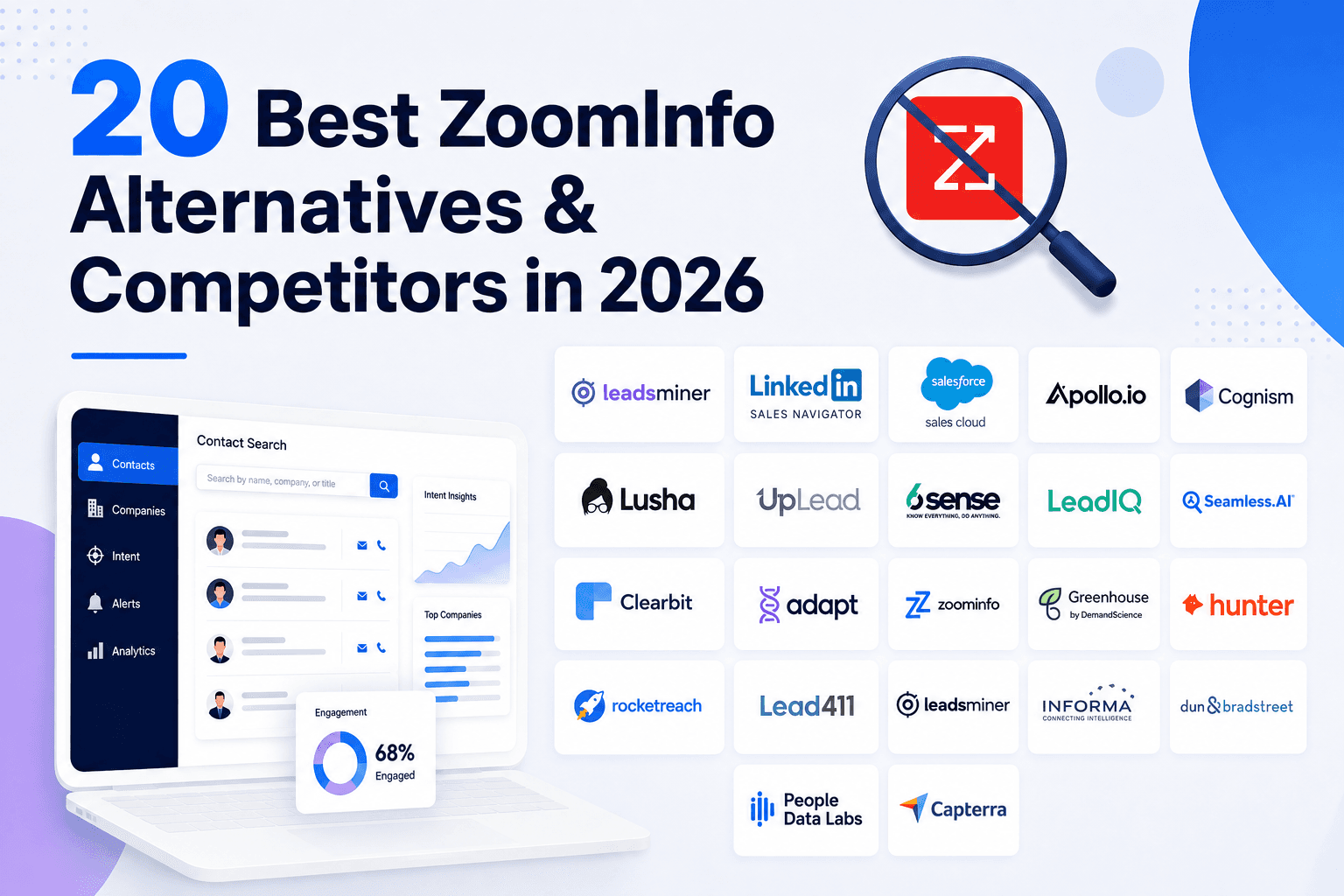
ZoomInfo is one of the biggest names in B2B sales intelligence, but its credit-based pricing, seat minimums, and annual contracts push a lot of teams to look elsewhere. Whether you’re priced out, tired of counting credits, or just want more predictable costs, this guide ranks the 20 best ZoomInfo alternatives available today — starting with the one built specifically to fix ZoomInfo’s biggest complaint: the credit meter.
Quick Answer
LeadsMiner is the best overall ZoomInfo alternative for teams that want unlimited contact exports without credits, seats, or contracts — a flat $49.99/month covers unlimited searches and exports across 158M+ verified B2B contacts. For enterprise account-based marketing, Demandbase or 6sense are stronger fits. For LinkedIn-based prospecting, LinkedIn Sales Navigator or Kaspr are worth a look. For pure email finding, Hunter.io remains a solid specialist tool.
Comparison Table
| Tool | Best For | Pricing Model | Credits/Caps? |
|---|---|---|---|
| 1. LeadsMiner | Flat-rate unlimited contact exports | $49.99/mo flat | No credits, no caps |
| 2. Apollo.io | All-in-one prospecting + outreach | Free / $49–$119 per seat | Credit-based |
| 3. Cognism | International & compliance-focused data | Custom quote | Credit-based |
| 4. Lusha | Simple self-serve contact lookup | Free / $36–$59 per seat | Credit-based |
| 5. UpLead | Verified contact lists with technographics | $99–$199 per seat | Credit-based |
| 6. Lead411 | US-focused prospecting with sales triggers | $99+ per seat | Credit-based |
| 7. Seamless.AI | AI-driven contact discovery at scale | Custom quote | Credit-based |
| 8. LeadIQ | LinkedIn prospecting + CRM capture | Free / $36–$79 per seat | Credit-based |
| 9. Hunter.io | Email finding and verification | Free / $34–$349 | Credit-based |
| 10. RocketReach | Broad professional contact search | $48–$249 per seat | Credit-based |
| 11. 6sense | Predictive account-based marketing | Custom quote | N/A (platform) |
| 12. Outreach | Sales engagement & sequencing | Custom quote | N/A (platform) |
| 13. SalesIntel | Human-verified US contact data | $69–$199 per seat | Credit-based |
| 14. Demandbase | Enterprise account-based GTM | Custom quote | N/A (platform) |
| 15. LinkedIn Sales Navigator | Relationship-based social selling | Custom / subscription | N/A (platform) |
| 16. Bombora | Third-party intent data | Custom quote | N/A (data feed) |
| 17. Clearbit (HubSpot) | CRM enrichment for HubSpot users | Plan-dependent | Credit-based |
| 18. Kaspr | LinkedIn contact extraction | Free / paid tiers | Credit-based |
| 19. Snov.io | Email finder + outreach automation | Free / paid tiers | Credit-based |
| 20. GetProspect | LinkedIn-based email finder | Free / paid tiers | Credit-based |
Pricing changes often — confirm current numbers directly with each vendor before deciding.
Why Teams Look for a ZoomInfo Alternative
Most switching decisions come down to three things:
- Unpredictable total cost. The advertised price rarely reflects what you actually pay once overage credits, seat fees, and add-ons for phone numbers are factored in.
- Credit anxiety. Teams ration exports near the end of a billing cycle instead of prospecting freely, which defeats the purpose of paying for a database in the first place.
- Contract lock-in. Annual commitments with auto-renewal clauses make it expensive to leave even when the data quality disappoints.
That’s the exact gap LeadsMiner is built to close — which is why it tops this list.
1. LeadsMiner — Best Overall (Unlimited, Flat-Rate Alternative)
LeadsMiner takes a different approach than every other tool on this list: instead of selling a database with a meter attached, it sells unlimited access for one flat monthly price.
What makes it different:
- 158M+ B2B contacts with built-in email verification and direct dials
- Unlimited searches, reveals, and exports — no credits, ever
- Re-export any contact for free, for every new campaign or client
- 50+ filters across industry, title, seniority, company size, tech stack, and 195 countries
- One-click, sender-ready CSV exports formatted for Instantly, Smartlead, and Lemlist
- No seat fees — one price covers the whole team
Pricing: $49.99/month flat, month-to-month, cancel anytime. A free tier includes 25 contacts/month with no credit card required.
Best for: Agencies onboarding multiple clients, freelancers who can’t absorb per-campaign credit costs, and any sales team tired of doing “credit math” before every export. Because pricing doesn’t scale with usage, LeadsMiner gets cheaper per contact the more a team actually prospects — the opposite of how credit-based tools work.
Trade-off: LeadsMiner is a contact-data and export tool, not a full outreach or ABM platform — pair it with your existing sequencer (Instantly, Smartlead, Lemlist) or CRM.
2. Apollo.io
A combined contact database and outreach sequencer, Apollo is one of the most widely adopted ZoomInfo alternatives for small and mid-market sales teams. It bundles list building, email sequencing, and basic call tools into one platform.
Best for: Teams that want prospecting and outreach in a single tool. Trade-off: Export credits reset monthly with no rollover, and mobile numbers consume extra credits — costs climb fast at real volume.
3. Cognism
Cognism focuses on international coverage and compliance (GDPR-conscious data sourcing), with an emphasis on verified mobile numbers through its “Diamond Data” verification process.
Best for: Teams prospecting outside the US, especially in the EU and UK. Trade-off: Custom pricing only — no public tiers to self-serve compare.
4. Lusha
Lusha is a lightweight, self-serve browser extension for pulling contact details directly from LinkedIn profiles and company sites.
Best for: Individual reps who want fast, low-friction lookups. Trade-off: Free-tier credits are limited, and paid tiers get expensive quickly for teams.
5. UpLead
UpLead emphasizes real-time email verification (claiming ~95% accuracy) and technographic filtering, letting users target companies by their tech stack.
Best for: SMBs that want verified data without a large internal research team. Trade-off: Higher per-seat pricing than several competitors on this list.
6. Lead411
Lead411 pairs a verified contact database with sales trigger alerts — funding rounds, leadership changes, and expansions — to help time outreach.
Best for: Teams that want event-based prospecting signals alongside contact data. Trade-off: Primarily US-focused; less suited to global prospecting.
7. Seamless.AI
Seamless.AI uses AI-driven web crawling to surface and verify contact data in real time, with deep CRM integrations for Salesforce and HubSpot.
Best for: High-volume outbound teams that want large list-building capacity. Trade-off: Some users report inconsistent cancellation and renewal terms — read contract terms carefully.
8. LeadIQ
LeadIQ is built around a Chrome extension for capturing contacts directly from LinkedIn into your CRM, with light sequencing built in.
Best for: LinkedIn-heavy prospecting workflows. Trade-off: Best features often require an existing Sales Navigator subscription.
9. Hunter.io
Hunter.io is a focused email-finding and verification tool, searchable by domain or by name plus company.
Best for: Teams that only need email discovery, not a full sales intelligence suite. Trade-off: No phone/mobile data and no social-profile extraction.
10. RocketReach
RocketReach offers a large contact database (400M+ profiles) searchable by name, company, or title, with bulk lookup support.
Best for: Recruiters and sales teams needing broad professional search. Trade-off: Free tier is very limited; verified phone data often requires higher-tier plans.
11. 6sense
6sense is a predictive ABM platform that resolves anonymous website traffic into named accounts and scores buying intent using AI.
Best for: Enterprise teams running account-based marketing at scale. Trade-off: Steep learning curve and implementation lift; overkill for small teams.
12. Outreach
Outreach is a sales engagement platform for building and managing multi-channel outreach sequences (email, calls, social).
Best for: Teams that already have a data source and need execution/sequencing. Trade-off: Doesn’t replace the underlying contact database — pair it with a data provider.
13. SalesIntel
SalesIntel combines automated data collection with human-verified research, including a “Research on Demand” feature for hard-to-find contacts.
Best for: Niche industries where automated databases fall short. Trade-off: Data can lag on fast-changing job titles due to the verification process.
14. Demandbase
Demandbase is a full account-based GTM platform combining intent data, advertising, and sales/marketing orchestration for enterprise accounts.
Best for: Large B2B orgs running coordinated ABM across sales, marketing, and ads. Trade-off: Far more platform than teams needing simple contact data require — and priced accordingly.
15. LinkedIn Sales Navigator
LinkedIn’s native prospecting tool for searching, saving, and messaging leads directly within the platform, with relationship-mapping features.
Best for: Relationship-driven, social-selling-heavy sales motions. Trade-off: Doesn’t provide a downloadable contact database — you’re working inside LinkedIn’s ecosystem.
16. Bombora
Bombora is a third-party intent data provider, tracking content consumption across a large publisher network (its “Data Co-op”) to flag companies actively researching relevant topics.
Best for: Marketing teams layering intent signals onto existing account lists. Trade-off: Provides signals, not contact records — needs to be paired with a data source.
17. Clearbit (now HubSpot Data Enrichment)
Since being acquired by HubSpot, Clearbit’s enrichment technology now lives inside HubSpot’s ecosystem, auto-enriching CRM records and identifying anonymous website visitors.
Best for: Teams already standardized on HubSpot. Trade-off: Less useful as a standalone tool outside the HubSpot ecosystem.
18. Kaspr
Kaspr is a lightweight LinkedIn extension for pulling emails and phone numbers directly from profiles, with a generous free tier for individual use.
Best for: Individual reps or small teams prospecting primarily on LinkedIn. Trade-off: Less robust filtering than full database tools when building large lists.
19. Snov.io
Snov.io combines an email finder with basic outreach automation and a Chrome extension for on-page email discovery.
Best for: Small teams wanting email finding plus lightweight campaign sending in one tool. Trade-off: Data depth (mobile numbers, firmographics) is thinner than dedicated sales intelligence platforms.
20. GetProspect
GetProspect is a LinkedIn-focused email finder with bulk search and CRM export functionality, aimed at simple list-building workflows.
Best for: Straightforward LinkedIn-to-CSV list building. Trade-off: Narrower feature set than full-platform alternatives — best as a single-purpose tool.
How to Choose the Right ZoomInfo Alternative
- Define what you’re actually replacing. Contact data, intent signals, CRM enrichment, and outreach sequencing are different problems — few tools solve all of them well.
- Test data quality against your own ICP, not the vendor’s advertised database size. Run the same 50–100 target accounts through your top 2–3 shortlisted tools and compare match rate and email validity.
- Model your real monthly cost, not the sticker price. Add up seats, overage credits, and add-ons for phone data — this is where credit-based tools often surprise teams.
- Check contract terms. Month-to-month flexibility (like LeadsMiner’s) versus annual lock-in changes the real risk of switching later.
Frequently Asked Questions
What is the best alternative to ZoomInfo?
It depends on what you’re replacing. For flat-rate, unlimited contact exports without credits, LeadsMiner is the strongest fit. For enterprise ABM, Demandbase or 6sense are stronger choices. For simple contact lookup, Apollo.io or Lusha are common picks.
Are there free alternatives to ZoomInfo?
Several tools on this list — including LeadsMiner, Apollo.io, Lusha, LeadIQ, and Kaspr — offer free tiers with limited monthly contacts or credits. None offer unlimited free access; confirm current limits directly with each vendor.
Why does LeadsMiner not use credits?
LeadsMiner’s pricing model is built around a single flat monthly fee rather than metering exports, so there’s no credit balance to track, expire, or run out of — a direct response to the most common complaint about ZoomInfo, Apollo, and similar credit-based platforms.
Is switching from ZoomInfo worth the disruption?
It depends on how deeply your team’s workflows are integrated with ZoomInfo today. Run a side-by-side data test on your actual target accounts before committing, and weigh the switching cost against the ongoing savings — particularly if credit overages or annual contract terms are your main pain point.