
B2B Inbound Marketing: What It Is and How to Do It in 2026
By Umair Gujjar·2026-08-25
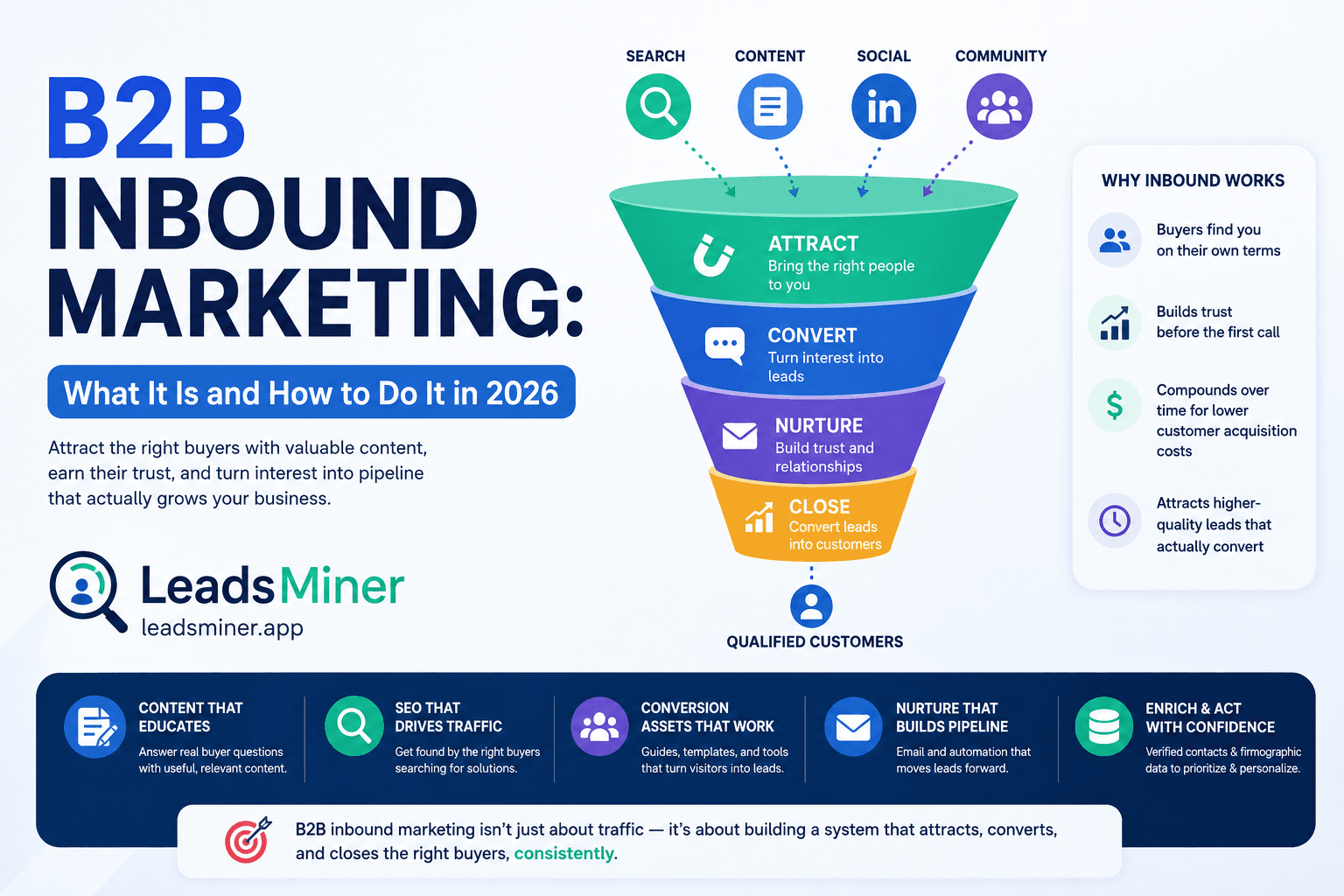
B2B inbound marketing is the practice of attracting buyers through content, search visibility, and owned channels — then converting that interest into pipeline, without ever cold-calling or cold-emailing them first. Instead of chasing prospects, you build something they find on their own: a blog post that answers their question, a guide that solves their problem, a LinkedIn post that earns a follow.
This guide covers what B2B inbound marketing actually looks like in practice, the funnel stages it depends on, how to measure whether it’s working, and where it breaks down if you don’t have a plan for what happens after someone raises their hand.
What Is B2B Inbound Marketing?
B2B inbound marketing attracts business buyers by creating value — content, tools, and resources — before asking for anything in return. The buyer finds you through search, social, or referral while researching a problem, engages with your content, and eventually converts into a lead on their own timeline.
This is the opposite of outbound marketing, where you initiate contact through cold email, cold calls, or paid ads targeted at people who haven’t expressed interest yet. Most mature B2B go-to-market strategies use both — inbound to capture demand that already exists, outbound to create awareness where it doesn’t yet.
Why B2B Inbound Marketing Still Works
Buyers do most of their research before ever talking to a sales rep. By the time someone fills out a form, they’ve often already read your website, compared you to competitors, and formed an opinion. Inbound marketing exists to shape that opinion in your favor before the conversation even starts.
It also compounds. A blog post published today keeps generating traffic and leads for years, unlike a cold email that has value once. That’s why content-driven lead generation is consistently reported as one of the highest-ROI, lowest-cost channels in B2B — even though it’s slower to show results than outbound.
The Core Components of a B2B Inbound Strategy
1. Content Marketing
Blog posts, guides, and long-form resources that answer the specific questions your buyers are searching for. Effective B2B content maps to where the buyer actually is — broad educational content for people who don’t know you exist yet, and specific comparison or proof content for people close to a decision.
2. SEO
Content only works as inbound marketing if people can find it. That means targeting keywords your buyers actually search, structuring pages so search engines (and increasingly, AI answer engines) can easily extract the answer, and building enough authority that Google trusts your site to rank.
3. Social and Community
A large share of B2B buyers now research on social platforms, not just search engines — particularly LinkedIn, where decision-makers follow industry voices during the exact window when they’re forming a preference. Communities (Slack groups, forums, niche Discords) work the same way at a smaller scale.
4. Conversion Assets
Guides, templates, calculators, and webinars that are valuable enough that a visitor will trade their contact information for them. This is where inbound marketing turns anonymous traffic into an actual lead.
5. Email and Nurture
Once someone converts, email nurture keeps them engaged until they’re ready to talk to sales — especially important in B2B, where sales cycles often run months, not days.
Mapping Content to the B2B Funnel
Not all content should do the same job. A common mistake is publishing only top-of-funnel blog content and having nothing for buyers who are already comparing vendors.
| Funnel Stage | Buyer Mindset | Content That Works | Goal |
|---|---|---|---|
| Top (TOFU) | Just realized they have a problem | Educational blog posts, industry data, short videos | Brand awareness, newsletter sign-up |
| Middle (MOFU) | Actively comparing solutions | In-depth guides, webinars, comparison pages, case studies | Content download, demo request |
| Bottom (BOFU) | Deciding between final options | Free trials, ROI calculators, customer testimonials, live demos | Meeting booked, trial started |
If your content is all TOFU, you’re generating awareness with no way to close the loop. If it’s all BOFU, you have nothing to attract people who aren’t ready to buy yet. Both gaps get filled by whichever competitor covers them first.
How to Measure Whether Inbound Marketing Is Working
Counting leads or form-fills alone is misleading — a form-fill means nothing if the lead never turns into a real deal. Track it further down the funnel instead:
- MQL-to-SQL conversion rate — of the leads content generates, how many does sales actually accept?
- Cost per opportunity, not cost per lead — a channel producing fewer, better leads can beat one producing many weak ones.
- Time from first touch to meeting booked — slow inbound follow-up is one of the most common ways teams lose deals they already earned.
- Win rate for inbound-sourced pipeline vs. other sources — this tells you whether inbound leads actually close, not just convert.
Last-click attribution tends to undercount inbound’s real impact, since B2B buyers touch multiple channels before converting. Where you can, ask new leads directly how they found you — self-reported attribution is often more accurate than what your analytics tools capture.
Where Most B2B Inbound Programs Break Down
The content and SEO side of inbound gets most of the attention, but the leak is usually downstream of that:
Slow follow-up. A lead who filled out a form an hour ago is far more likely to respond than one who filled it out three days ago. Inbound interest decays fast, and manual routing is often the bottleneck.
No enrichment at the point of capture. A name and email address alone isn’t enough for sales to prioritize a lead. Without company size, title, and industry attached immediately, reps waste the first few minutes of “hot” lead time just researching who they’re talking to instead of reaching out.
Weak or unverified contact data. Inbound leads sometimes fill out forms with typos, personal emails, or incomplete information. If your team is also running outbound in parallel — following up on inbound signals with a broader account-based push, or filling pipeline gaps between inbound waves — that same data-quality problem shows up again: bad emails bounce, wasted sends hurt deliverability, and reps lose time chasing contacts that don’t exist.
This is usually where teams end up layering a contact database and verification tool alongside their inbound program — not to replace inbound, but to make sure the moment a lead does convert (or the moment your team wants to proactively reach a similar account), the contact information behind it is accurate and immediately actionable. Tools like LeadsMiner fit this gap: verified emails and direct dials for outbound follow-up on inbound signals, without the credit-metering that makes teams ration how many leads they can actually enrich or act on in a given month.
Common Mistakes to Avoid
| Mistake | Why It Hurts | Fix |
|---|---|---|
| Publishing only awareness-stage content | Attracts traffic that never converts | Build MOFU/BOFU assets with clear conversion paths |
| Treating lead volume as the success metric | Sales drowns in leads that never close | Track cost-per-opportunity and win rate by source |
| Slow or manual lead routing | Intent decays within hours | Automate follow-up triggers on form-fills |
| Relying on one channel (usually just SEO) | Misses buyers who research via social or communities | Distribute content across search, social, and email |
| No enrichment on inbound leads | Reps waste time researching instead of reaching out | Enrich contact and firmographic data at the moment of capture |
Frequently Asked Questions
What’s the difference between inbound and outbound marketing?
Inbound attracts buyers who come to you through content, search, and social; outbound initiates contact with people who haven’t expressed interest yet, through cold email, cold calls, or targeted ads. Most B2B companies run both, using inbound to capture existing demand and outbound to create new pipeline.
How long does B2B inbound marketing take to show results?
Inbound is generally slower to produce results than outbound or paid channels — often three to six months before content starts generating consistent traffic and leads — but it compounds over time in a way one-off outbound campaigns don’t.
Do I need a large content team to do inbound marketing well?
No. A small, consistent output of content that’s genuinely useful to your specific buyer will usually outperform a large volume of generic content. Depth and specificity matter more than sheer output.
How does lead enrichment fit into an inbound strategy?
When someone converts on an inbound asset (a form fill, demo request, or content download), enrichment adds firmographic details — company size, industry, job title — automatically, so sales can prioritize and personalize follow-up immediately instead of researching the lead manually first.